
PAST EVENTS 2015
![toyama[3]](http://thecenter.mit.edu/wp-content/uploads/2012/05/toyama3-150x150.jpg)
Over the last four decades, America experienced a golden age of digital innovation. Yet during the same span of time, the rate of poverty stayed put, social mobility stagnated, and inequality skyrocketed to levels not seen for a century. How is it that our most advanced technologies failed to impact our deepest social challenges?
This talk presents technology’s Law of Amplification — a simple idea that explains why gadgets alone consistently fail to deliver social progress, and why in an age of advanced technology, it’s all the more important to focus on nurturing human wisdom.

He is the author of numerous articles and papers on international economic issues, including: The Search for Efficiency in the Adjustment Process: Spain in the 1980s; The European Monetary System: Developments and Perspectives (co-author); Fiscal Policy Issues During the Transition in Russia, Ten Years of Russian Economic Reform; Reforming the IMF; Interdependence, Cooperation, and the Emergence of Global Institutions; Chile: the Next State of Development; The Role of International Financial Organizations During the Transition in Russia; Israel: Factors in the Emergence of an ICT Powerhouse (co-author); The Innovation Capacity Index: Factors, Policies, and Institutions Driving Country Innovation, and many others. His interests include the role of interdependence and cooperation in the emergence of global institutions, elements of a successful approach to economic development, and aspects of management of the globalization process.
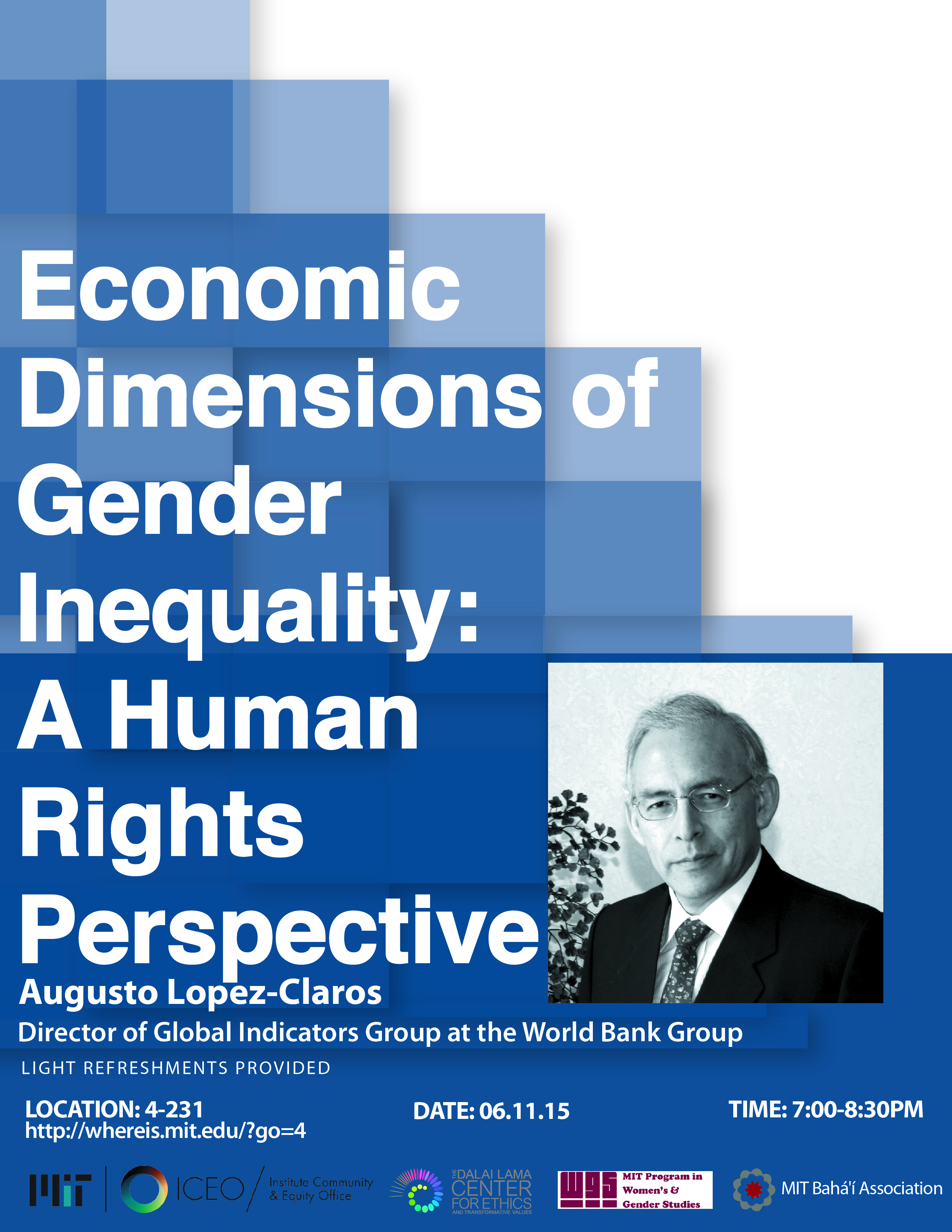
Click here for flyer.
In my lecture I will first illustrate the physically fundamental manifestation of anthropogenic climate change: the ocean’s heat content increases because of the greenhouse effect from rising greenhouse-gas concentrations. This increase in heat content has gone on unabated for at least the past forty years. Then I will show that differences between different model simulations – and hence also differences between simulations and observations – are dominated by chance events if we consider temperature changes over periods as short as fifteen years. By contrast, it matters little whether models respond more or less sensitively to increasing greenhouse-gas concentrations, if we only consider changes over fifteen years. The difference between simulated and observed global surface temperature changes during the hiatus period thus tells us very little about model capability or lack thereof, and as an indicator of anthropogenic climate change the surface-warming hiatus is largely irrelevant.
Sponsored by the MIT Department of Earth, Atmospheric and Planetary Sciences and the Center for Global Change Science
In addition to being a scholar and meditation master, as well as painter, poet, songwriter and playwright, the Gyalwang Karmapa is an avid environmentalist.
Co-sponsored with CCARE at Stanford University



Education for Peace: Compassionate Young Leaders (Colombia)December 4-5, 2015Venue: ColombiaBy Invitation Only.Co-sponsor(s): FENALPER, USAID, El SpectadorTransformative Teachers (Mexico)Venue: Mexico-cityBy Invitation Only..Transformative Leadership (Mexico)November 19-21, 2015Venue: Queretaro, MexicoBy Enrollment OnlyGeek Heresy: What’s Essential in an Age of Advanced TechnologyKentaro ToyamaTuesday, November 3, 2015 at 4:30PMVenue: Bartos Theater, MITOpen to General PublicKentaro Toyama is W.K. Kellogg Associate Professor at the University of Michigan School of Information, a fellow of the Dalai Lama Center for Ethics and Transformative Values at MIT, and author of Geek Heresy: Rescuing Social Change from the Cult of Technology. In previous lives, he co-founded Microsoft Research India and taught at Ashesi University in Ghana.Abstract:Over the last four decades, America experienced a golden age of digital innovation. Yet during the same span of time, the rate of poverty stayed put, social mobility stagnated, and inequality skyrocketed to levels not seen for a century. How is it that our most advanced technologies failed to impact our deepest social challenges?This talk presents technology’s Law of Amplification — a simple idea that explains why gadgets alone consistently fail to deliver social progress, and why in an age of advanced technology, it’s all the more important to focus on nurturing human wisdom.Leading with PurposeWednesday, October 7, 2015 | 5:00 pmVenue: MIT Sloan (E51, Room 335)Open to General PublicBREATHE Hackathon WeekendSeptember 19-20, 2015Compassionate Young Leaders: Global MauliolaSeptember 14-18, 2015Venue: The Kohala Center, Hawai'iBy Invitation Only.For several years, The Kohala Center, the Edith Kanaka‘ole Foundation, and the Dalai Lama Center for Ethics and Transformative Values at MIT have been in conversation about the possibility of connecting ancestral knowledge with research to address critical issues at the intersection of human and natural systems and science. These include energy self-reliance and food self-reliance. With a powerful and indigenous foundation of living in abundant self-reliance, of humanity living in kinship with nature, Hawai‘i operates with a spirit of aloha, a sense of generosity and care in communities both human and natural. And this despite the fact that Hawai‘i Island currently imports 85% of the food consumed on the island and is 95% dependent on fossil fuels for the production of energy. This dependence has a tremendous impact on the socio-economic and environmental health of Hawai‘i and the physical and spiritual health of its people. Thus, Hawai‘i models contemporary challenges, as well as indigenous success, with regard to sustainability and the well-being of our entire island planet.Transformative Leadership (Queretaro, Mexico)September 3-5, 2015Venue: Queretaro, MexicoBy Enrollment OnlyTransformative Leadership (Mexico-city, Mexico)August 27-29, 2015Venue: Mexico-cityBy Enrollment OnlyYoung Peace Leaders (Colombia)August 18-25, 2015Venue: Universidad del Rosario, Bogota, ColombiaGames for Ethics and Character Development: A Workshop at MITTransformative Leadership (Mexico)a program on secular ethics and leadership for executivesJuly 2-4, 2015Venue: EBC, Mexico-cityBy Enrollment Only.Transformative Teachers (US)A Program for Transformative Teachers: Cultivating Resilient and Ethical Young LeadersSummer 2015Click here for more information.Ethics and WisdomThe Venerable Tenzin PriyadarshiJune 18, 2015Venue: Suntec City, SingaporeWisdom 2.0 Asia ConferenceReThinking Leadership: A Contemplative ApproachThe Venerable Tenzin PriyadarshiJune 17, 2015Venue: Google, SingaporeEconomic Dimensions of Gender InequalityAugusto Lopez-ClarosJune 11, 2015 at 7PMVenue: 4-231 MITOpen to General PublicSince March of 2011 Augusto López-Claros is Director of Global Indicators and Analysis with the World Bank Group. He was Chief Economist and Director of the Global Competitiveness Program at the World Economic Forum in Geneva, where he was the editor of the Global Competitiveness Report, the Forum’s flagship publication, as well as a number of regional economic reports. Before joining the Forum he was Executive Director with Lehman Brothers (London) and Senior International Economist. He was the International Monetary Fund’s resident representative in the Russian Federation during 1992-95. Before joining the IMF, he was professor of economics at the University of Chile in Santiago. López-Claros was educated in England and the United States, receiving a diploma in Mathematical Statistics from Cambridge University and a Ph.D. in Economics from Duke University.He is the author of numerous articles and papers on international economic issues, including: The Search for Efficiency in the Adjustment Process: Spain in the 1980s; The European Monetary System: Developments and Perspectives (co-author); Fiscal Policy Issues During the Transition in Russia, Ten Years of Russian Economic Reform; Reforming the IMF; Interdependence, Cooperation, and the Emergence of Global Institutions; Chile: the Next State of Development; The Role of International Financial Organizations During the Transition in Russia; Israel: Factors in the Emergence of an ICT Powerhouse (co-author); The Innovation Capacity Index: Factors, Policies, and Institutions Driving Country Innovation, and many others. His interests include the role of interdependence and cooperation in the emergence of global institutions, elements of a successful approach to economic development, and aspects of management of the globalization process.Transformative Leadership (Cornell)May 1-2, 2015Venue: Cornell UniversityBy Enrollment Only.Creativity and Healthy AgingJoi Ito, Tenzin Priyadarshi, Maryanne Kirkbride, David VagoApril 21, 2015 at 4:30PMVenue: Tang Center, MITOpen to General PublicStratton Lecture on Aging SuccessfullyClick here for flyer.Recent Global Temperature Trends: What do they tell us about anthropogenic climate change?Jochem Marotzke, Max-Planck Institut Für MeteorologieWednesday, April 15, 2015 | 5:00 pmVenue: MIT Wong Auditorium, E51-115Observations suggest a hiatus in global surface temperature rise since 1998, whereas most climate models simulate continued warming. What causes this difference? Do climate models respond too sensitively to the increase in greenhouse-gas concentrations such as that of CO2, and thus overestimate climate change systematically? Or has the discrepancy arisen by chance? And what is the relevance of this discrepancy for our assessment of long-term anthropogenic climate change?In my lecture I will first illustrate the physically fundamental manifestation of anthropogenic climate change: the ocean’s heat content increases because of the greenhouse effect from rising greenhouse-gas concentrations. This increase in heat content has gone on unabated for at least the past forty years. Then I will show that differences between different model simulations – and hence also differences between simulations and observations – are dominated by chance events if we consider temperature changes over periods as short as fifteen years. By contrast, it matters little whether models respond more or less sensitively to increasing greenhouse-gas concentrations, if we only consider changes over fifteen years. The difference between simulated and observed global surface temperature changes during the hiatus period thus tells us very little about model capability or lack thereof, and as an indicator of anthropogenic climate change the surface-warming hiatus is largely irrelevant.Sponsored by the MIT Department of Earth, Atmospheric and Planetary Sciences and the Center for Global Change ScienceHow Can Young People Take Ownership of Their Future? A Lecture by Dr. James HansenJames HansenTuesday, April 14, 2015 | 4:00 pmVenue: MIT Wong Auditorium E51-115Dr. James Hansen, formerly Director of the NASA Goddard Institute for Space Studies, is an Adjunct Professor at Columbia University’s Earth Institute, where he directs the Program on Climate Science, Awareness and Solutions. He was trained in physics and astronomy in the space science program of Dr. James Van Allen at the University of Iowa. His early research on the clouds of Venus helped identify their composition as sulfuric acid. Since the late 1970s, he has focused his research on Earth’s climate, especially human-made climate change. Dr. Hansen is best known for his testimony on climate change to congressional committees in the 1980s that helped raise broad awareness of the global warming issue. He was elected to the National Academy of Sciences in 1995 and was designated by Time Magazine in 2006 as one of the 100 most influential people on Earth. He has received numerous awards including the Carl-Gustaf Rossby and Roger Revelle Research Medals, the Sophie Prize and the Blue Planet Prize. Dr. Hansen is widely recognized for his efforts to outline actions that the public must take to protect the future of young people and other life on our planet.Transformative Leadership (Mexico)April 9-11, 2015Venue: Mexico-cityBy Enrollment Only.Compassion, Technology, & Environment | A Talk by the KarmapaHis Holiness the XVIIth Gyalwang KarmapaMarch 17, 2015 at 5PMVenue: Memorial Auditorium, Stanford UniversityGyalwang Karmapa is the head of the 900 year old Karma Kagyu school of Tibetan Buddhism and guide to millions of Buddhists around the world.In addition to being a scholar and meditation master, as well as painter, poet, songwriter and playwright, the Gyalwang Karmapa is an avid environmentalist.Click here to register.Co-sponsored with CCARE at Stanford UniversityTiny Cells, Global Impact43rd James R. Killian Jr. Faculty Award LectureProfessor Sallie Chisholm, Lee and Geraldine Martin Professor of Environmental Studies in the Department of Civil and Environmental Engineering and the Department of BiologyTuesday, March 10, 2015 (4PM-5:30PMVenue: 10-250 MITOpen to General PublicThe James R. Killian Jr. Faculty Achievement Award was established in 1971 to recognize extraordinary professional accomplishments by full-time members of the MIT faculty. It is the greatest honor the faculty can bestow upon one of its members. A faculty committee chooses the recipient from among candidates nominated by their peers for outstanding contributions to their fields, to MIT, and to society.Transformative Leadership (Mexico)February 19-21, 2015Venue: EBC, Mexico-cityBy Enrollment Only.Human Rights, Ethics and Values: On Personal and Social TransformationA Talk by Venerable Tenzin PriyadarshiFebruary 17, 2015Venue: University of Alabama, BirminghamOpen to General PublicTransformative TeachersA Program for Transformative Teachers: Cultivating Resilient and Ethical Young LeadersFebruary 17, 2015Venue: Birmingham, AlabamaBy Enrollment Only.Transformative Teachers (India)January 22-23, 2015Venue: India Habitat Center, New DelhiBy Enrollment Only.Program open to active middle an high school teachers in India. In partnership with Foundation for Universal Responsibility, New Delhi.