
PAST EVENTS 2016
Transformative Leadership (Mexico)
People, Power & Purpose
December 6-8, 2016
Venue: Mexico-city, Mexico
By Invitation Only.
Film Screening and Conversation: Under the Turban (MIT)
Wednesday, November 30, 2016 at 7PM
Venue: Wong Auditorium, Tang Center, MIT
Open to General Public
DIRECTOR: SATINDER GARCHA
Satinder is the founder and chief executive of Elevations Development Pte Ltd., a boutique property developer known for it’s high-end, impeccably designed residences. With an interest in pairing upscale properties with artistic innovation Satinder has partnered with some of the world’s most renown architects and designers such as Zhaha Hadid, Robert Stern and Anouska Hemple in creating the building and interiors for the Elevations’ Properties.
An entrepreneur at heart, Satinder began his career creating the company People.com in 1995. People.com brought together his background in computer science with the burgeoning needs of the Silicon Valley’s then recent creation, the Internet. People.com, a human resources company paired the needs of the emerging cyber world with programmers and developers in India. In 2000 Satinder sold the company and moved to Singapore where he currently resides.
Interested in questions about identity in the global era, this film is Satinder’s personal investigation into Sikhism. This is his first documentary feature.
Satinder is the founder and chief executive of Elevations Development Pte Ltd., a boutique property developer known for it’s high-end, impeccably designed residences. With an interest in pairing upscale properties with artistic innovation Satinder has partnered with some of the world’s most renown architects and designers such as Zhaha Hadid, Robert Stern and Anouska Hemple in creating the building and interiors for the Elevations’ Properties.
An entrepreneur at heart, Satinder began his career creating the company People.com in 1995. People.com brought together his background in computer science with the burgeoning needs of the Silicon Valley’s then recent creation, the Internet. People.com, a human resources company paired the needs of the emerging cyber world with programmers and developers in India. In 2000 Satinder sold the company and moved to Singapore where he currently resides.
Interested in questions about identity in the global era, this film is Satinder’s personal investigation into Sikhism. This is his first documentary feature.

Followed by conversations with Director Satinder Garcha
ReThinking Values in Education (Chennai, India)
The Venerable Tenzin Priyadarshi
November 21, 2016 at 9AM
Venue: St. Franis Hall, Stella Maris College, Chennai (India)
Students and Faculty Only.
Uncompromising Ethics For Compromised World (India)
Conversations with HE Samdhong Rinpoche and Venerable Tenzin Priyadarshi
November 19, 2016 at 6PM
Venue: Madras School of Economics, Chennai
Co-sponsored by Chennai International Center.
ReThinking Education
Talk by Venerable Tenzin Priyadarshi
October 21, 2016
Venue: Hawaii Convention Center
Schools of the Future Conference
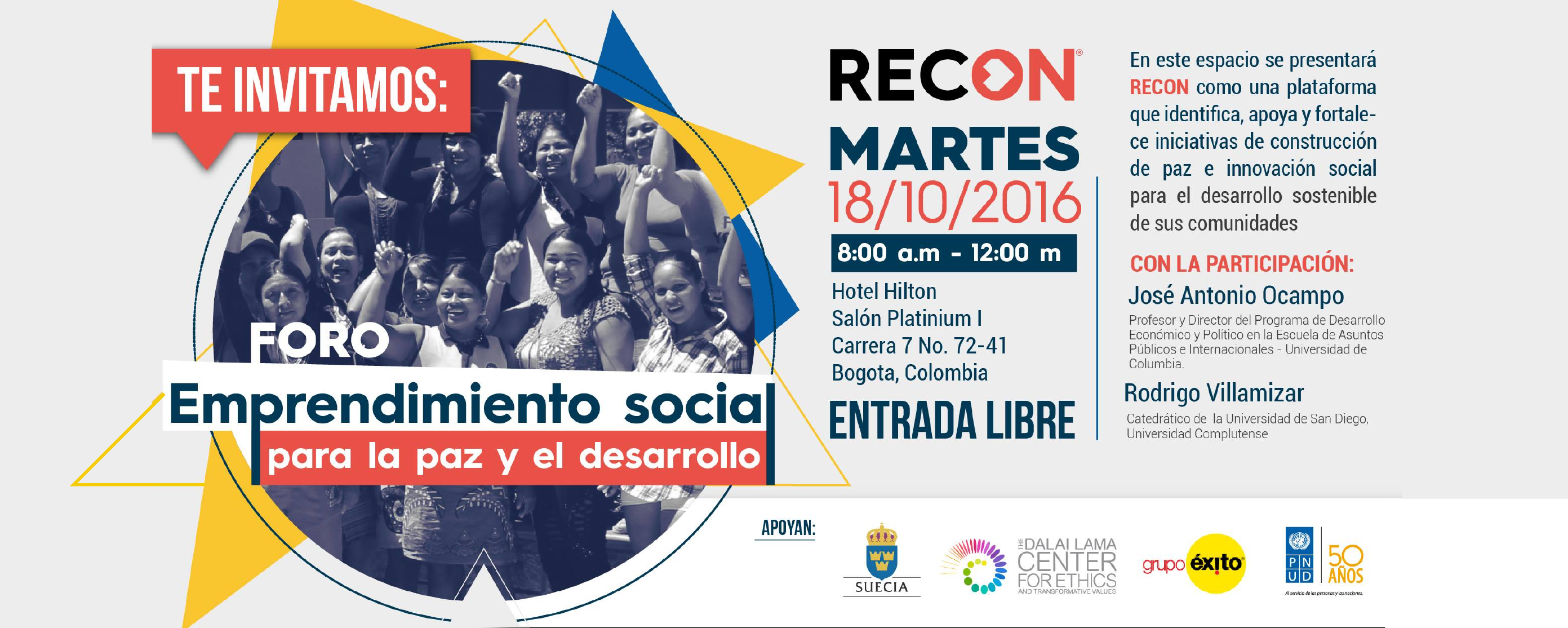
Social Entrepreneurship for Peace and Development (Colombia)
October 18, 2016
Venue: Bogota, Colombia
There Is No AI Ethics: What Machine Prejudice Teaches Us About Ourselves
Professor Joanna Bryson
Monday, October 17, 2016 (3PM-4:30PM)
Venue: E14-240, MIT
Abstract:
While many scan the foreseeable time horizon looking for killer robots with glowing eyes, or for amorphous superintelligent puppet masters, humanity has been quietly augmenting itself with artificial intelligence for decades if not centuries. To understand the long-term consequences of AI we need first to better examine our present. Here in joint work with Aylin Caliskan-Islam and Arvind Narayanan I show that human-like semantic biases are present in standard the standard NLP tools GloVe and word2vec applied to their standard Web-sourced corpora. We have replicated a spectrum of standard human biases as exposed by the Implicit Association Test and other well-known psychological studies. Our results indicate that language itself contains recoverable and accurate imprints of our historic biases, whether these are morally neutral as towards insects or flowers, problematic as towards race or gender, or even simply veridical, reflecting the status quo for the distribution of gender with respect to careers or first names. These regularities are captured by machine learning along with the rest of semantics. I will describe these results, and also their implications both for human and AI ethics, which I will argue should be considered as one.
Bio:
Joanna Bryson is a Reader (tenured Associate Professor) at the University of Bath, currently visiting Princeton’s Center for Information Technology Policy (CITP). She has broad academic interests in the structure and utility of intelligence, both natural and artificial. She is best known for her work in systems AI and AI ethics, both of which she began during her PhD in the 1990s, but she and her colleagues publish broadly, into biology, anthropology, sociology, philosophy, cognitive science, and politics. She is currently collaborating on a project funded by Princeton’s University Center for Human Values, “Public Goods and Artificial Intelligence”, with Alin Coman of Princeton Psychology and Mark Riedl of Georgia Tech. This project includes both basic research in human sociality and experiments in technological interventions. Other current research includes work on understanding the causality behind the link between wealth inequality and political polarization, work on transparency in AI systems, and work on machine prejudice deriving from human semantics. She holds degrees in Psychology from Chicago and Edinburgh, and in Artificial Intelligence from Edinburgh and MIT. At Bath she founded the Intelligent Systems research group (one of four in the Department of Computer Science) and heads their Artificial Models of Natural Intelligence.Sponsor(s): MIT Media Lab Scalable Cooperation Group
While many scan the foreseeable time horizon looking for killer robots with glowing eyes, or for amorphous superintelligent puppet masters, humanity has been quietly augmenting itself with artificial intelligence for decades if not centuries. To understand the long-term consequences of AI we need first to better examine our present. Here in joint work with Aylin Caliskan-Islam and Arvind Narayanan I show that human-like semantic biases are present in standard the standard NLP tools GloVe and word2vec applied to their standard Web-sourced corpora. We have replicated a spectrum of standard human biases as exposed by the Implicit Association Test and other well-known psychological studies. Our results indicate that language itself contains recoverable and accurate imprints of our historic biases, whether these are morally neutral as towards insects or flowers, problematic as towards race or gender, or even simply veridical, reflecting the status quo for the distribution of gender with respect to careers or first names. These regularities are captured by machine learning along with the rest of semantics. I will describe these results, and also their implications both for human and AI ethics, which I will argue should be considered as one.
Bio:
Joanna Bryson is a Reader (tenured Associate Professor) at the University of Bath, currently visiting Princeton’s Center for Information Technology Policy (CITP). She has broad academic interests in the structure and utility of intelligence, both natural and artificial. She is best known for her work in systems AI and AI ethics, both of which she began during her PhD in the 1990s, but she and her colleagues publish broadly, into biology, anthropology, sociology, philosophy, cognitive science, and politics. She is currently collaborating on a project funded by Princeton’s University Center for Human Values, “Public Goods and Artificial Intelligence”, with Alin Coman of Princeton Psychology and Mark Riedl of Georgia Tech. This project includes both basic research in human sociality and experiments in technological interventions. Other current research includes work on understanding the causality behind the link between wealth inequality and political polarization, work on transparency in AI systems, and work on machine prejudice deriving from human semantics. She holds degrees in Psychology from Chicago and Edinburgh, and in Artificial Intelligence from Edinburgh and MIT. At Bath she founded the Intelligent Systems research group (one of four in the Department of Computer Science) and heads their Artificial Models of Natural Intelligence.Sponsor(s): MIT Media Lab Scalable Cooperation Group
Transformative Teachers (Colombia)
September 21-23, 2016
Venue: Bogota, Colombia
By Enrollment Only.
Transformative Leadership (Yale)
Friday, September 9, 2016
Venue: Yale SOM, New Haven CT
By Enrollment Only.
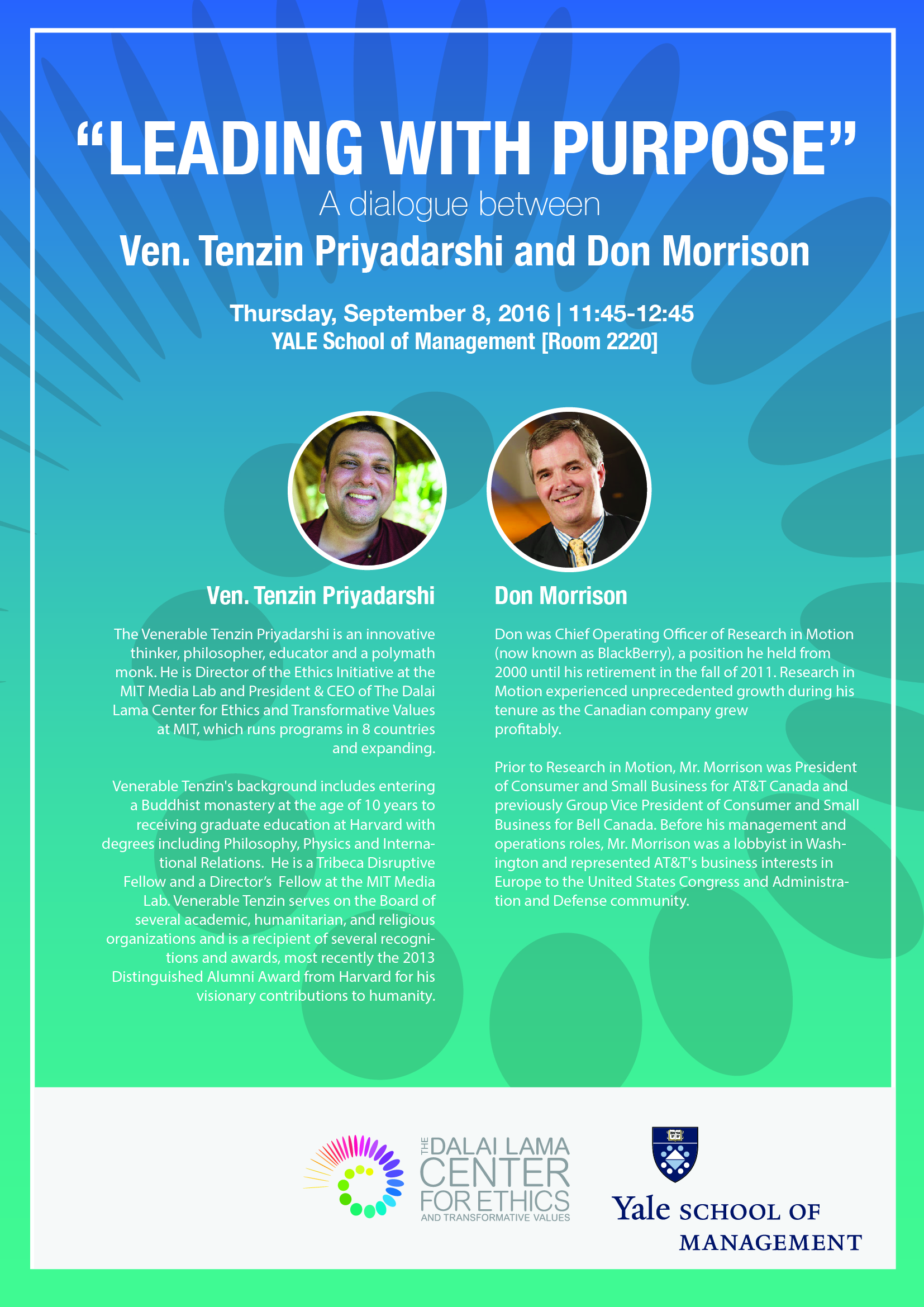
Leading with Purpose
Don Morrison and Tenzin Priyadarshi
Thursday, September 8, 2016
Venue: Yale SOM, New Haven, CT
Ethical Leadership (India)
Power, Trust and Citizenship Building
August 23, 2016 at 11AM
Venue: National Police Academy, Hyderabad, India
By Enrollment Only.
Leading with Purpose (India)
August 23, 2016
Venue: Hyderabad, India
By Invitation Only.
Sponsored by Entrepreneurs’ Organization (EO)
Refining Problems for Innovative Solutions
Monday, August 22, 2016 at 5:30PM
Venue: T-Hub, Hyderabad, India
Click here to register.
Compassionate Young Leaders | PA
August 8-10, 2016
Venue: Newtown, PA
By Enrollment Only.
Transformative Leadership | Mexico-city
August 4-6, 2016
Venue: Mexico-city
By Enrollment Only.
Transformative Teachers | Cambridge, MA
Compassionate Young Leaders
July 6-8, 2016
Venue: Newtown, PA
By Invitation Only.
In partnership with The Project for STEM Foundation Competitiveness
Transformative Leadership (Mexico-city)
May 19-21, 2016
Venue: EBC, Mexico-city
By Enrollment Only.
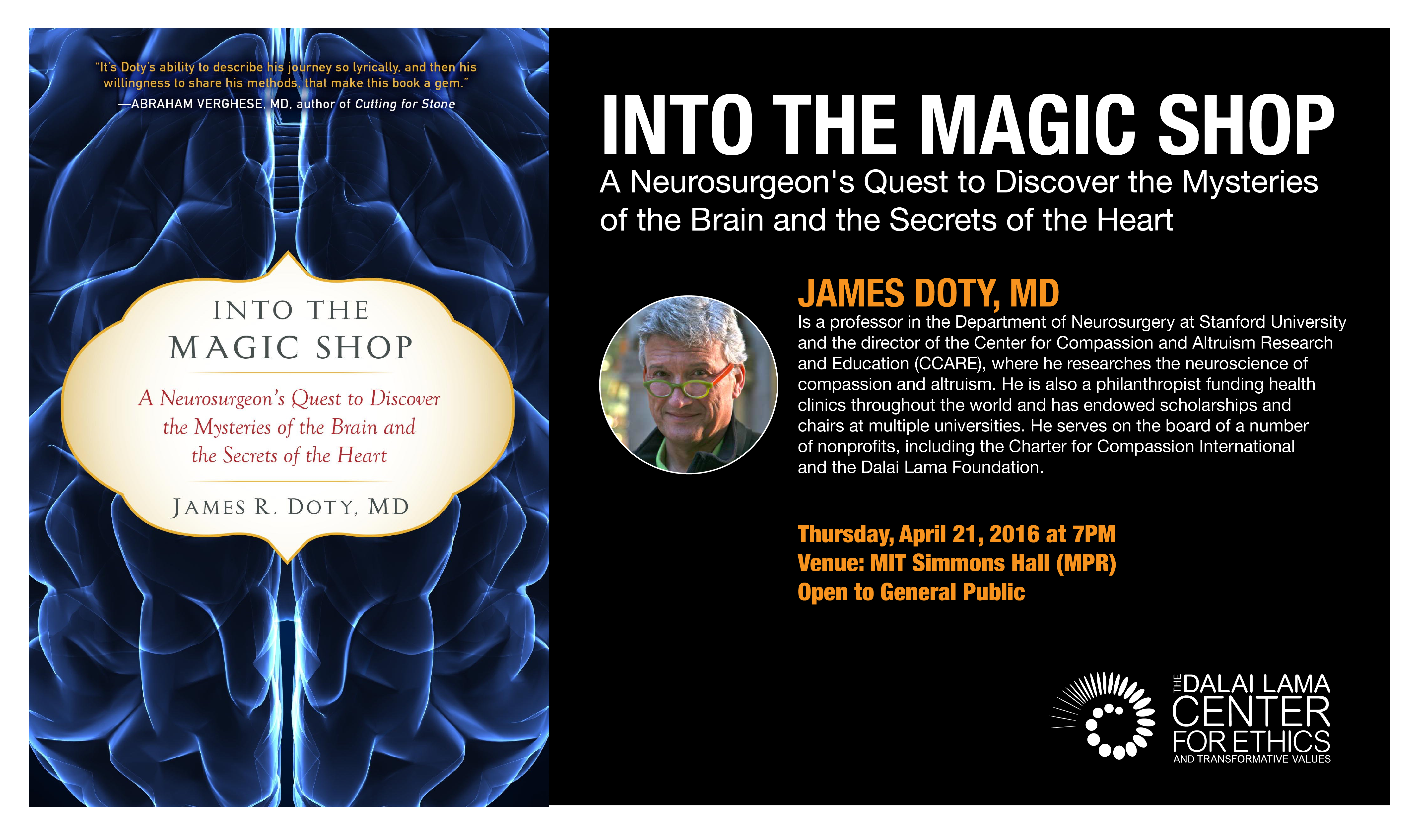
James Doty, MD: Into the Magic Shop
A Neurosurgeon's Quest to Discover the Mysteries of the Brain and the Secrets of the Heart
James Doty, MD and Tenzin Priyadarshi
Thursday, April 21, 2016 at 7PM
Venue: MIT Simmons Hall (MPR)
Open to General Public

James R. Doty, M.D., is a professor in the Department of Neurosurgery at Stanford University and the director of the Center for Compassion and Altruism Research and Education (CCARE), where he researches the neuroscience of compassion and altruism. He is also a philanthropist funding health clinics throughout the world and has endowed scholarships and chairs at multiple universities. He serves on the board of a number of nonprofits, including the Charter for Compassion International and the Dalai Lama Foundation.
Co-sponsored by Resident Scholars @ MIT Simmons Hall, MIT ORL and Prajnopaya.
Transformative Leadership (Stanford)
Transformative Leadership (Yale SOM)
April 8-9, 2016
Venue: Yale School of Management, New Haven
By Enrollment Only.
Shaka Senghor: Writing My Wrongs
Shaka Senghor, Joi Ito, Tenzin Priyadarshi
Wednesday, March 16, 2016 | 6:00pm
Venue: MIT Media Lab, Bartos Theater

In 1991, Shaka Senghor was sent to prison for second-degree murder. Today, he is a lecturer at universities, a leading voice on criminal justice reform, and an inspiration to thousands.
In life, it’s not how you start that matters. It’s how you finish.
Shaka Senghor was raised in a middle class neighborhood on Detroit’s east side during the height of the 1980s crack epidemic. An honor roll student and a natural leader, he dreamed of becoming a doctor—but at age 11, his parents’ marriage began to unravel, and the beatings from his mother worsened, sending him on a downward spiral that saw him run away from home, turn to drug dealing to survive, and end up in prison for murder at the age of 19, fuming with anger and despair.
Writing My Wrongs is the story of what came next. During his nineteen-year incarceration, seven of which were spent in solitary confinement, Senghor discovered literature, meditation, self-examination, and the kindness of others—tools he used to confront the demons of his past, forgive the people who hurt him, and begin atoning for the wrongs he had committed. Upon his release at age thirty-eight, Senghor became an activist and mentor to young men and women facing circumstances like his. His work in the community and the courage to share his story led him to fellowships at the MIT Media Lab and the Kellogg Foundation and invitations to speak at events like TED and the Aspen Ideas Festival.
In equal turns, Writing My Wrongs is a page-turning portrait of life in the shadow of poverty, violence, and fear; an unforgettable story of redemption, reminding us that our worst deeds don’t define us; and a compelling witness to our country’s need for rethinking its approach to crime, prison, and the men and women sent there.
Transformative Teachers (Mexico)
Tenzin Priyadarshi and Peter Stidwill
March 11-12, 2016
Venue: EBC, Mexico-city
By Enrollment Only.
Extraordinary Leadership: Transforming Yourself to Transform Others
Tenzin Priyadarshi
Wednesday, March 2, 2016 at 6PM IST
Venue: Hyderabad, India
Hosted by Manthan
Transformative Leadership (Mexico)
January 28-30, 2016
Venue: Querétaro, Mexico
By Enrollment Only.